 Polytoolhub

What is Adjacent?
Adjacent turns individual event contracts into broader research products: indices, reference rates, dashboards and market commentary. Use its thematic views when the research question spans several contracts, or compare its benchmarks with your own basket. Its news product explains developments through market probabilities and changes in activity.
Who it is for
- Researchers building a thematic view across event contracts
- Publishers looking for market-based context for news
- Teams that need benchmark methodology or a custom index
Features and coverage
- Available on
- Web, Email, API
- Markets & venues
- Polymarket, Multiple prediction markets
- Research topics
- Indices, Reference rates, Market news
- Thematic indices
Explore groups of event contracts organized around a common subject.
- Categorical and return-based benchmarks
Separate the topic being tracked from the construction and return methodology of an index.
- Reference rates
Use a dedicated rates surface alongside the index and market views.
- Research dashboards
Move between aggregate products and the underlying market-oriented research.
- Daily and weekly coverage
Read briefings about probability moves, volume, volatility and upcoming catalysts.
- Methodology library
Consult governance and construction documents before using an index in a comparison.
- Data API and custom indices
Follow the API entry point or request a bespoke index for a specific research requirement.
- Different index scales
A probability-based index uses 50–150: subtract 50 to obtain the implied win probability. A total-return index starts at 100 and measures cumulative return; the probability conversion does not apply. Points indices follow their own methodology.
- Public snapshot delay
Public index, reference-rate and market catalog data use a snapshot tier delayed by 15 minutes. The indexer refreshes public snapshot tables every 15 minutes; the public surface is not a live execution feed.
Workflows with Adjacent
Build a thematic watchlist
Choose an index, read its construction methodology and identify which underlying events it represents. Use the market and news views to investigate changes in the benchmark.
Prepare a market-based briefing
Start with the daily or weekly newsletter, isolate the relevant contract or theme and use the dashboard for quantitative context.
Evaluate a benchmark for a product
Check the methodology and reference-rate definitions before requesting API access or a custom index.
Interpret a composite index
Identify the index type and read the methodology for its ticker. Inspect effective leaf-market weights when a composite contains child indices, then compare the underlying venue outcomes rather than treating every index level as a probability.
Pricing and total cost
Public pages include index discovery and editorial coverage. API access and custom-index work have separate inquiry paths; a complete fee schedule is not listed on the main page.
Getting started
- Open Indices or Dashboards and select the topic you need.
- Read the matching methodology before interpreting an index level.
- Use Markets and News to investigate the contracts behind a move.
- Subscribe to the daily or weekly coverage if useful.
- Use the API or custom-index inquiry for a data integration.
Useful links
What to check
- An index is a constructed basket or benchmark; its value need not equal the probability of one event.
- Index methodology determines constituent selection and interpretation.
- The news and benchmark products are research surfaces, separate from venue order entry.
A closer look
Ratings & reviews
User reviews 0
The main score switches to user ratings after 5 published reviews.
A specific example helps the next person choose the right tool.
Related tools
Browse category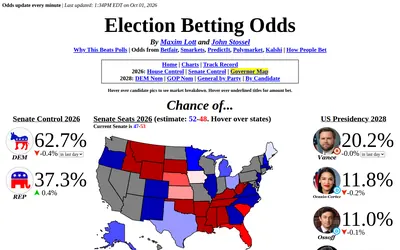
Compare election probabilities across venues, inspect bid–ask ranges and follow historical charts and state-level maps.
- Access Web
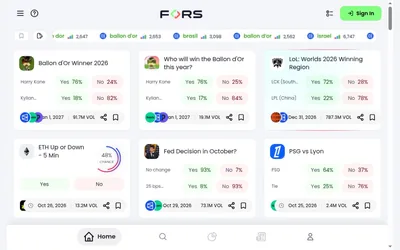

Compare prediction-market events and explore analytics and copy workflows through FORS.
- Access Web
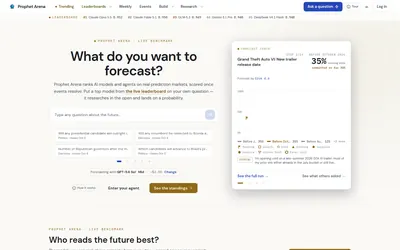

Compare AI forecasters using resolved-event scores, then run a model on your question and inspect its research trace.
- Access Web
Frequently asked questions about Adjacent
Is Adjacent only a newsletter?
No. It also provides indices, reference rates, dashboards and data access.
Can I request an index for my own topic?
The site has a custom-index inquiry.
How should I interpret an index level?
Use the methodology for that specific index; thematic and return-based products measure different things.
Can I place a Polymarket order here?
The reviewed entry points focus on research and market data.
Can every Adjacent index level be converted to a win probability?
No. Subtracting 50 applies only to a probability-based index. Total-return and points indices have different units, and a reference rate is a comparison benchmark rather than a tradable contract.