 Polytoolhub
What is prediction-market-analysis?
Prediction Market Analysis combines pre-collected Polymarket and Kalshi data with indexers and a framework for research scripts. Its Parquet organization is suited to repeatable empirical work: collect metadata and trades, apply an analysis and save the output as charts or tables.
Who it is for
- Researchers studying market behavior and trader outcomes
- Analysts who want a downloadable trade dataset
- Python developers extending existing collection and analysis scripts
Features and coverage
- Available on
- Python, Parquet, CLI
- Markets & venues
- Polymarket, Kalshi
- Pre-collected data
Start from the downloadable market and trade archive.
- Two-venue organization
Keep Polymarket and Kalshi datasets in separate directories.
- Collection indexers
Gather market metadata and trade history from supported APIs and blockchain sources.
- Resumable progress
Interrupt and resume collection through saved state.
- Parquet storage
Query columnar market, trade and block files.
- Extensible analyses
Add scripts within the analysis framework.
- Multiple outputs
Generate PNG, PDF, CSV and JSON results.
Workflows with prediction-market-analysis
Reproduce a research figure
Download the dataset, inspect the schema and run the corresponding analysis. Save the input version and filters with the output.
Extend an empirical question
Add a custom analysis using the shared interfaces and output structured intermediate tables alongside the figure.
Refresh a dataset
Select the relevant indexer and resume from saved progress, then record the new coverage boundary.
Pricing and total cost
MIT-licensed code and a public downloadable dataset. Local storage, compute and any collection-provider access are your operating costs.
Getting started
Before you start: The documented compressed archive is 36 GiB; extraction needs additional disk space.
- Use Python 3.9 or newer and install with uv.
- Allocate disk space for the compressed archive and extracted data.
- Read the market and trade schemas.
- Download the pre-collected dataset or run a selected indexer.
- Run a bounded analysis before expanding the workload.
- Keep derived outputs separate from source data.
Useful links
What to check
- The documented compressed archive is 36 GiB; extraction needs additional disk space.
- A trade-history dataset does not provide a full historical resting order book.
- The packaging command removes the data directory after creating the archive.
- Dataset cutoffs and coverage differ from a live service.
- Research results depend on how transfers, open positions and resolved trades are treated.
A closer look
Ratings & reviews
User reviews 0
The main score switches to user ratings after 5 published reviews.
A specific example helps the next person choose the right tool.
Write a review
How was your experience with prediction-market-analysis?
Share what you used, what worked and what could be better. We confirm your email and review the submission before publishing.
To submit a review, email info@polytradingbot.com with the tool name, your rating and your experience. Enable JavaScript to prepare a draft here.
Related tools
Browse category
Download free Polymarket order-book captures with hourly Parquet files, schema notes, checksums and coverage audits.
- Access Parquet, DuckDB, Python
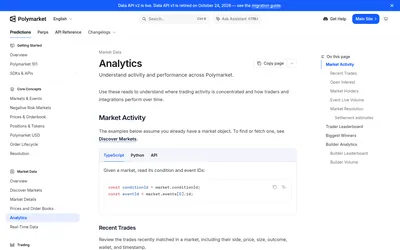

Build wallet dashboards and market analytics from public positions, activity, trades, holders, open interest and rankings.
- Data coverage Positions · Account activity
- Access API
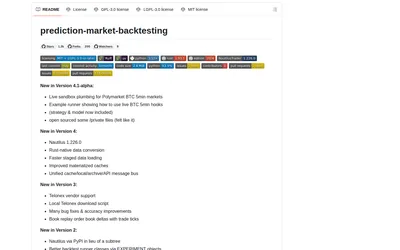
Build Polymarket strategy replays on NautilusTrader with historical vendor data, joint portfolios, parameter experiments and detailed charts.
- Language Python · Rust
Frequently asked questions about prediction-market-analysis
Can I start without collecting everything myself?
Yes. A pre-collected archive is provided.
Can collection resume after interruption?
The indexers save progress.
Where do charts and tables go?
Analyses write their outputs under the output directory.
Does the archive support exact L2 replay?
Its core contents are market and trade data; use a dedicated book archive for resting-depth reconstruction.