 Polytoolhub
What is Pendulum Flow Orderbook Archive?
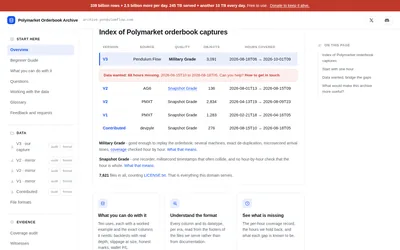
Pendulum Flow is a file archive for people who want to inspect and process the captured market stream themselves. It combines its own multi-recorder V3 capture with older mirrored datasets. The version matters: timing precision, event ordering and coverage differ between capture eras.
Who it is for
- Researchers reconstructing historical books
- Data engineers building local Polymarket datasets
- Analysts who need inspectable provenance and coverage
Features and coverage
- Available on
- Parquet, DuckDB, Python
- Markets & venues
- Polymarket
- Hourly Parquet
Read a bounded hour rather than downloading the entire archive.
- Full snapshots and deltas
Combine book events with price_change rows to reconstruct resting depth.
- Trade and lifecycle events
Access trade prices, new markets, resolutions and tick-size changes where recorded.
- Capture provenance
V3 includes receive timestamps, witness fields and sequence information.
- Checksums and manifests
Verify files and inspect event-type counts before processing.
- Coverage audit
Review missing hours and capture-era limitations.
- Remote columnar reads
Use DuckDB or another Parquet reader to request only relevant columns and row groups.
Workflows with Pendulum Flow Orderbook Archive
Reconstruct a book
Pick an audited V3 interval, load a snapshot and apply the subsequent level changes for one token. Preserve receive ordering and handle the hour boundary explicitly.
Study historical slippage
Rebuild both sides of the book, walk resting levels for a chosen size and compare the result with the contemporaneous midpoint.
Create a reproducible research extract
Save source paths, checksums, era and filters with the derived dataset.
Pricing and total cost
Free public downloads without an account or API key. Donations support capture, storage and delivery.
Getting started
Before you start: V1, V2 and V3 have different schemas and capture fidelity.
- Choose the time range in the coverage index.
- Read the format page for that capture era.
- Inspect the hourly manifest and checksum.
- Query a small set of columns and one market first.
- Sort using the era’s documented time and sequence semantics.
- Record missing intervals alongside the result.
Useful links
What to check
- V1, V2 and V3 have different schemas and capture fidelity.
- V3 receive timestamps use microseconds; older mirrored records commonly use milliseconds.
- Collector sequence values are not a global exchange ordering across machines.
- Published-hour delay and a missing recorded hour are different conditions.
- An hourly file can exceed a gigabyte; use a columnar query engine instead of a spreadsheet.
A closer look
Ratings & reviews
User reviews 0
The main score switches to user ratings after 5 published reviews.
A specific example helps the next person choose the right tool.
Write a review
How was your experience with Pendulum Flow Orderbook Archive?
Share what you used, what worked and what could be better. We confirm your email and review the submission before publishing.
To submit a review, email info@polytradingbot.com with the tool name, your rating and your experience. Enable JavaScript to prepare a draft here.
Related tools
Browse category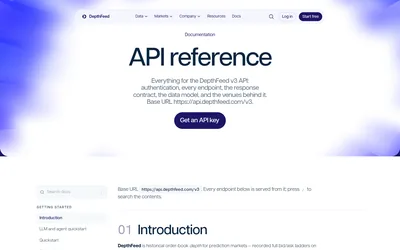
Retrieve full historical order books, sports market data and aligned price bars for research, replay and liquidity analysis.
- Data coverage Order books · Prices · Sports events
- Access API · MCP
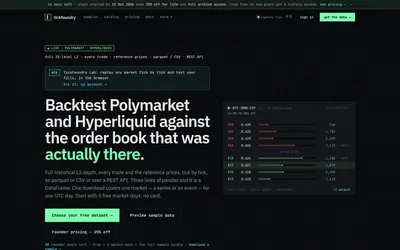

Download historical market-day bundles or replay books and trades in a browser to inspect execution costs at a chosen size.
- Access Web · API
Access the earlier PMXT Polymarket capture eras through a public mirror, with version-specific formats and documented coverage gaps.
- Access Parquet, Python, DuckDB
Frequently asked questions about Pendulum Flow Orderbook Archive
Do I need to download every hour?
No. Choose a bounded interval and use Parquet column and row-group filtering.
Which events carry resting quantities?
Book snapshots and price-change deltas are needed for depth reconstruction.
Is the archive one consistent capture?
No. Inspect the version and audit because older eras come from other collectors.
Can I verify a file?
Each prefix publishes checksums, and V3 hours also have manifests.