 Polytoolhub
What is PMXT open-source SDK?
PMXT is a client-and-backend toolkit that normalizes market and trading methods across supported venues. The open-source option is useful when you want venue-native credentials and control over the local runtime. The same language clients can also target PMXT’s hosted service, which has different credentials and supported write paths.
Who it is for
- Developers integrating several prediction venues
- Teams that prefer operating their own backend
- Applications migrating from venue-specific clients or Dome-style data access
Features and coverage
- Available on
- Python, TypeScript, Node.js
- Markets & venues
- Multiple supported prediction venues
- Python and TypeScript clients
Use pmxt or pmxtjs with a shared high-level interface.
- Local backend
Run pmxt-core rather than relying on hosted PMXT infrastructure.
- Venue adapters
Query markets, books, positions and orders where supported.
- Capability matrix
The repository tracks differences between venues and methods.
- CLI and MCP pathways
Related packages expose the same ecosystem to terminals and assistants.
- Migration tooling
The repository includes documented support for Dome-style integrations.
Workflows with PMXT open-source SDK
Prototype across two venues
Make the same bounded market query through each adapter, compare returned identifiers and check the feature matrix before adding orders.
Choose the runtime deliberately
Use the hosted mode when you want its catalog infrastructure, or local pmxt-core for venue-native credentials and self-operated execution.
Pricing and total cost
The code is MIT-licensed and free to self-host. You pay for your runtime, storage and applicable venue costs. Hosted PMXT plans are a separate service.
Getting started
Before you start: The Python local workflow still requires Node.js for the backend.
- Use the official repository and package links.
- Install the selected language client and required Node runtime for local pmxt-core.
- Choose hosted or self-hosted mode explicitly.
- Read markets without enabling writes.
- Add only the venue credentials and methods needed by your application.
Useful links
What to check
- The Python local workflow still requires Node.js for the backend.
- Supported methods and write access vary by venue and mode.
- Hosted catalog IDs and venue-native IDs must be used in the correct context.
- Installing the open-source package does not grant hosted plan allowances.
A closer look
Ratings & reviews
User reviews 0
The main score switches to user ratings after 5 published reviews.
A specific example helps the next person choose the right tool.
Write a review
How was your experience with PMXT open-source SDK?
Share what you used, what worked and what could be better. We confirm your email and review the submission before publishing.
To submit a review, email info@polytradingbot.com with the tool name, your rating and your experience. Enable JavaScript to prepare a draft here.
Related tools
Browse category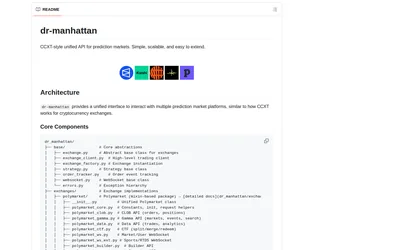
Use a common Python interface for prediction-market discovery, orders, positions and streaming, with optional MCP access.
- Language Python
- Access API · MCP
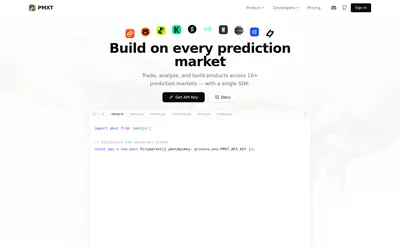
One hosted API key for cross-venue market search, matching, historical data and supported prediction-market trading methods.
- Data coverage Markets · Events · Order books · Prices · Cross-venue matches
- Access API
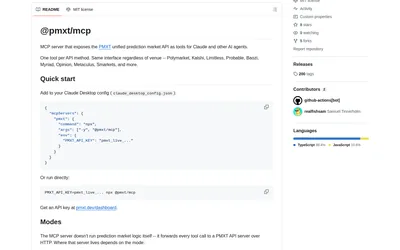
Expose PMXT market discovery, book data and supported account or order methods to an MCP-compatible assistant.
- Access MCP
Frequently asked questions about PMXT open-source SDK
Is the Python client entirely Python at runtime?
The self-hosted workflow uses the Node-based pmxt-core backend.
Can I use it without a PMXT API key?
Self-hosted mode uses the local backend and venue-native access where required.
Does every venue support every method?
No. Check the feature-support matrix.