 Polytoolhub
What is PMXT hosted API?
PMXT’s hosted service supplies a shared market catalog and common response shapes across supported venues. Its Router searches across the catalog, groups matching or related markets and compares prices. Python and TypeScript clients expose the same high-level methods, with support determined by each venue and runtime mode.
Who it is for
- Developers building multi-venue research applications
- Teams that want hosted catalog and matching infrastructure
- Applications combining market discovery with supported execution
Features and coverage
- Available on
- REST API, WebSocket, Python, TypeScript
- Markets & venues
- Polymarket, Kalshi, Limitless, Smarkets, Other supported venues
- Unified market schema
Work with Event, Market and Outcome objects across venue clients.
- Router search
Search the hosted catalog with one query.
- Matched clusters
Inspect related-market groups, relation types and confidence scores.
- Historical data
Access hosted candle history and order-book snapshots under the applicable plan.
- Venue methods
Use shared method names such as market queries, position reads and order creation where implemented.
- Hosted trading
The documented hosted write path uses PreFundedEscrow custody.
- Client choice
Use Python pmxt or TypeScript pmxtjs.
Workflows with PMXT hosted API
Compare an event across venues
Search with Router, inspect the matched cluster and retain its relation type and confidence. Read the relevant bid/ask data before choosing the venue-specific client.
Build a hosted integration
Create a key, make a small read request and budget both REST calls and WebSocket messages. Add writes only through the documented hosted account flow.
Pricing and total cost
Free, Starter and Pro plans meter hosted data by credits.
Free
$0/month
- 25,000 credits/month
- 60 requests/minute
- 5 WebSocket streams
Starter
$29.99/month
- 250,000 credits/month
- 300 requests/minute
- 20 streams
Pro
$99.99/month
- 1 million credits/month
- 1,000 requests/minute
- 100 streams
Fees and usage costs
- One REST call costs one credit; one WebSocket message costs 0.1 credits.
- Published plans are for personal use; enterprise access is quoted separately.
Getting started
Before you start: Hosted writes use a different custody and credential model from self-hosting.
- Create a PMXT hosted API key.
- Install the official Python or TypeScript client.
- Initialize a venue client or Router with the key.
- Request a few markets, then inspect matched clusters and venue support.
- Use the hosted trading quickstart for account and execution setup.
Useful links
What to check
- Hosted writes use a different custody and credential model from self-hosting.
- Hosted catalog IDs and venue-native IDs are not interchangeable in every flow.
- A common method name does not mean every venue implements it.
- Published data plans are limited to personal use.
A closer look
Ratings & reviews
User reviews 0
The main score switches to user ratings after 5 published reviews.
A specific example helps the next person choose the right tool.
Write a review
How was your experience with PMXT hosted API?
Share what you used, what worked and what could be better. We confirm your email and review the submission before publishing.
To submit a review, email info@polytradingbot.com with the tool name, your rating and your experience. Enable JavaScript to prepare a draft here.
Related tools
Browse category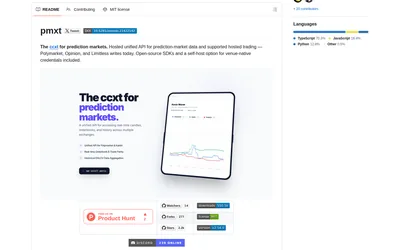
Use Python or TypeScript clients with a common prediction-market interface, targeting hosted PMXT or a locally run backend.
- Language Python · TypeScript
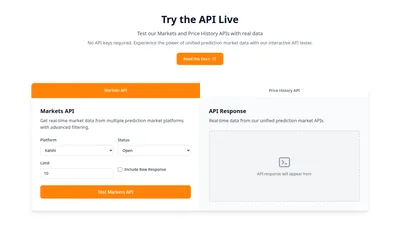

Build with one API for markets, order books, price history and sports data across seven venues.
- Data coverage Markets · Events · Order books · Trades · Prices · Sports events
- Access API · MCP
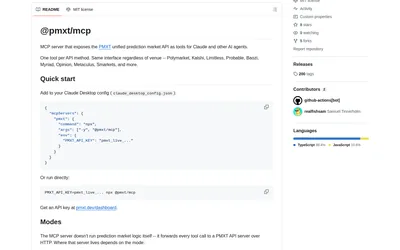
Expose PMXT market discovery, book data and supported account or order methods to an MCP-compatible assistant.
- Access MCP
Frequently asked questions about PMXT hosted API
How is hosted PMXT different from the open-source SDK?
Hosted mode uses PMXT infrastructure and an API key. Self-hosted mode runs pmxt-core locally and uses venue-native access.
What consumes a credit?
One REST call costs one credit; a WebSocket message costs 0.1.
Does matching mean two contracts have identical settlement terms?
Clusters include relation types and confidence; inspect the underlying contracts.