 Polytoolhub

What is National Weather Service API?
The National Weather Service API exposes forecasts, observations and alerts through documented machine-readable endpoints. It is an external research input for U.S. weather questions, not a prediction-market trading service.
The distinction between forecast and observation is crucial. A daily maximum contract may depend on a named station, local reporting day and specific settlement publication, which a nearby forecast grid does not automatically reproduce.
Who it is for
- Developers building U.S. weather research tools
- Researchers checking forecasts against observations
Features and coverage
- Available on
- API
- Weather endpoints
Retrieve documented forecast, alert and observation data.
- Machine-readable formats
Use GeoJSON and other documented representations.
- Operational guidance
Read caching, rate-limit, feature-flag and outage information.
Workflows with National Weather Service API
Build a location feed
Follow the official examples to map the intended location to the appropriate forecast or station data.
Check settlement relevance
Compare station, unit and reporting period with the contract’s specified source before interpreting a reading.
Pricing and total cost
The official API documentation states that access is free, subject to reasonable unpublished rate limits.
Access: A descriptive User-Agent is required. Follow the current documentation for authentication and content negotiation.
Getting started
- Read the official API examples and specification.
- Identify the required location, station and data type.
- Use the documented headers and caching behaviour, then validate timestamps and units.
Useful links
What to check
- The API’s forecast is not a final observed settlement value. Geographic coverage, station choice, missing observations and update timing matter.
A closer look
Ratings & reviews
User reviews 0
The main score switches to user ratings after 5 published reviews.
A specific example helps the next person choose the right tool.
Related tools
Browse category

Research inflation, employment, GDP and other economic series with FRED’s charts and release calendar.
- Access Web
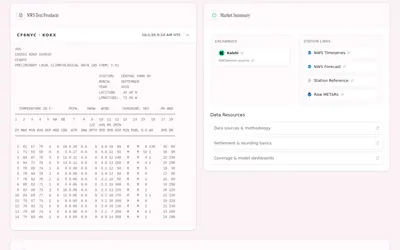

Research weather contracts using station-specific observations, forecasts, official weather reports and market coverage by city.
- Access Web


Retrieve cited research answers through a JSON API for forecasting and event-analysis workflows.
- Access API
Frequently asked questions about National Weather Service API
Is an hourly forecast the same as the final daily maximum?
No. A forecast is an estimate; the contract may require a specific observed station statistic.
Does the API charge per request?
The official documentation describes free access with rate limits rather than a per-request price.
What does National Weather Service API cost?
The official API documentation states that access is free, subject to reasonable unpublished rate limits.
What access does National Weather Service API require?
A descriptive User-Agent is required. Follow the current documentation for authentication and content negotiation.