 Polytoolhub
What is Marketlens?
Marketlens combines a historical data API with a Python backtesting engine. It is useful when a price chart is too coarse: order-book data lets you investigate executable depth, queue assumptions and price impact. The archive begins on March 1, 2026 for covered markets, with coverage checked per market.
Who it is for
- Quant researchers replaying execution against historical books
- Developers building datasets from trades and candles
- Teams budgeting large historical exports
Features and coverage
- Available on
- API, Python
- Markets & venues
- Polymarket
- Research topics
- Backtesting, Historical data
- Historical L2 data
Retrieve book depth, trades and candles for covered markets.
- Python strategy replay
Handle book updates, trades, fills, rejects and market boundaries in strategy callbacks.
- Simulated account state
Access balances, positions, order controls and split/merge operations.
- Export budgeting
Run a dry-run quote before requesting a large export; repeated downloads of the same completed export do not consume new row charges.
- Pagination
List endpoints use opaque cursors; the SDK can paginate automatically.
- Execution assumptions
Control latency, queue and fill settings instead of assuming every displayed price is executable.
Workflows with Marketlens
Backtest one market
Find a covered market, obtain its history and run a small strategy with stated latency and fill assumptions. Inspect fills and positions before scaling to many markets.
Build a research export
Set the market and time range, request a dry-run estimate and compare it with your row allowance. Save the completed export for repeatable local analysis.
Pricing and total cost
Free includes 2 million rows once and a recent seven-day market-access window. Pro is $39/month; Scale is $199/month.
Free
$0
- 2 million rows once
- Recent seven-day access window
Pro
$39/month
- 5 billion rows/month
- 3,600 requests/minute
- 5 API keys
- Full archive
Scale
$199/month
- 50 billion rows/month
- 10,800 requests/minute
- 25 API keys
- Full archive
Fees and usage costs
- Paid plans include one-month rollover of unused rows.
- A separate daily request-unit budget also applies. Limits aggregate across a user’s keys.
Getting started
Before you start: An archive start date does not mean every market has continuous data from that date.
- Create an API key in the Marketlens console.
- Install the documented marketlens Python package or use REST.
- Set MARKETLENS_API_KEY and request a small market list.
- Check coverage and obtain a dry-run quote before exporting history.
- Run a one-market replay and inspect the resulting fills and account state.
Useful links
What to check
- An archive start date does not mean every market has continuous data from that date.
- Cursors expire after 24 hours.
- A history-store failure can cause a backtest market to be skipped; inspect effective coverage.
- Queue, latency and fill assumptions materially affect a replay.
A closer look
Ratings & reviews
User reviews 0
The main score switches to user ratings after 5 published reviews.
A specific example helps the next person choose the right tool.
Write a review
How was your experience with Marketlens?
Share what you used, what worked and what could be better. We confirm your email and review the submission before publishing.
To submit a review, email info@polytradingbot.com with the tool name, your rating and your experience. Enable JavaScript to prepare a draft here.
Related tools
Browse category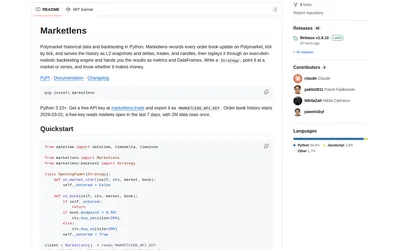
Retrieve historical Polymarket books and run either tick-level execution simulations or faster bar-based signal backtests in Python.
- Language Python
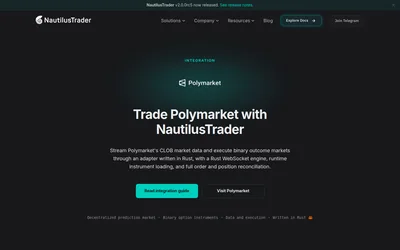

Use a Rust-native Polymarket adapter inside NautilusTrader for live feeds, signed execution and strategy research.
- Language Python · Rust
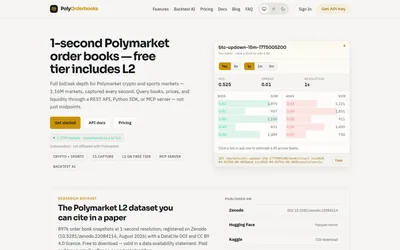

Query historical Polymarket crypto and sports order books at 250 ms resolution, or replay a crypto strategy against recorded depth.
- Access Web · API · MCP
Frequently asked questions about Marketlens
How is this different from downloading a price chart?
L2 history contains the book depth needed to study fills and liquidity, while a chart typically summarizes prices.
Can I estimate an export before paying in rows?
Yes. The documented dry-run quote is designed for export budgeting.
Can I use my own Python strategy?
Yes. The replay engine exposes strategy callbacks and simulated account controls.