 Polytoolhub
What is Alphapoly (Chainstack)?
Alphapoly combines a Python backend and browser frontend around a staged relationship-analysis pipeline. It groups markets, asks an LLM to extract and validate implications, then calculates portfolio costs from current prices. Its V2 trading path uses a per-user Deposit Wallet.
Who it is for
- Technical researchers analyzing related contract pairs
- Developers inspecting a multi-stage LLM market pipeline
- Users who want a standalone application rather than an agent skill
Features and coverage
- Available on
- Web, Python, Node.js
- Markets & venues
- Polymarket
- Market grouping
Collect related Polymarket contracts into groups.
- Implication extraction
Identify candidate logical relationships between groups.
- Pair validation
Evaluate the relationship at the individual-contract level.
- Portfolio calculation
Combine validated pairs with current market prices.
- Position interface
Enter and monitor supported paired positions in the browser.
- Deposit-wallet setup
Use the documented signer and Relayer API key path for V2 account setup.
- Research scripts
Inspect separate pipeline, funding and forked-chain experiments.
Workflows with Alphapoly (Chainstack)
Review a related-market opportunity
Run the pipeline, inspect the implication and validate the two resolution rules. Compare the combined entry cost and available size before entering either leg.
Develop one pipeline stage
Use the corresponding standalone experiment to inspect grouping, validation or scoring before changing the full application.
Configure V2 execution
Set the signer and relayer credentials, deploy the supported Deposit Wallet and verify its identity before funding.
Pricing and total cost
Apache-2.0 source. Model-provider usage, RPC access, infrastructure and venue costs are separate.
Getting started
Before you start: The current trading path uses pUSD and Deposit Wallets; the v1-final branch describes the retired USDC.e stack.
- Install uv and Node.js 18 or newer.
- Configure the environment for the backend, RPC and model provider.
- Install dependencies and start the backend and frontend.
- Run a bounded research pipeline.
- For execution, follow the V2 Deposit Wallet and relayer setup.
- Inspect the selected pair and account before an entry.
Useful links
What to check
- The current trading path uses pUSD and Deposit Wallets; the v1-final branch describes the retired USDC.e stack.
- Forked-chain OTC experiments use an older frozen state and are not the live V2 execution path.
- A logical relationship suggested by an LLM needs to hold under both contracts’ exact resolution rules.
- Opening a pair involves two legs whose execution can differ.
A closer look
Ratings & reviews
User reviews 0
The main score switches to user ratings after 5 published reviews.
A specific example helps the next person choose the right tool.
Write a review
How was your experience with Alphapoly (Chainstack)?
Share what you used, what worked and what could be better. We confirm your email and review the submission before publishing.
To submit a review, email info@polytradingbot.com with the tool name, your rating and your experience. Enable JavaScript to prepare a draft here.
Related tools
Browse category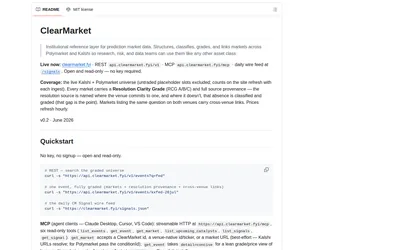
Inspect resolution-source quality, catalysts and cross-venue question links through a public reference API and MCP server.
- Access Web · API · MCP
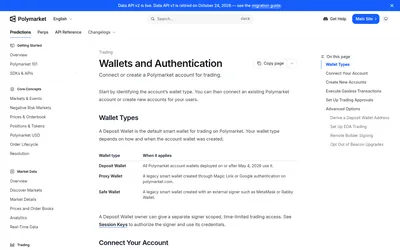

Submit authorized wallet transactions for approvals, transfers and position operations without requiring the account to hold POL for gas.
- Access API
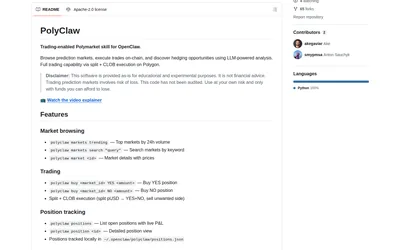
Give OpenClaw market discovery, wallet commands, position tracking and an LLM-assisted search for covering market pairs.
- Access CLI
Frequently asked questions about Alphapoly (Chainstack)
How does it differ from PolyClaw?
Alphapoly is a standalone backend and web application; PolyClaw is an OpenClaw skill.
Does it simply trade correlations?
Its pipeline seeks and validates logical implications between contract questions.
Which wallet path does the current version use?
Per-user Deposit Wallets with a signer and Relayer API key.
Are the OTC experiments the production trading path?
No. They operate on a forked older chain state.