 Polytoolhub
What is Polynode?
Polynode provides both live event streams and historical REST data. A central feature is server-side filtering: an application can subscribe to the wallets, tokens, market slugs or trade sizes it needs instead of processing a complete firehose. The stream distinguishes detected activity from later confirmation updates. Polynode is now part of Agg, with its existing APIs and documentation retained.
Who it is for
- Developers building wallet alerts or copy-trading infrastructure
- Teams that need filtered live data and historical backfills
- Researchers combining settlements, books and market metadata
Features and coverage
- Available on
- REST API, WebSocket, SDK, CLI
- Markets & venues
- Polymarket
- Research topics
- Event streams, Data infrastructure
- Filtered WebSockets
Combine wallet, token, side, size, status and market filters in a subscription.
- Pre-confirmation detection
Receive detected settlement activity and track the later status updates separately.
- Enriched market metadata
Keep question, slug, outcomes, volume and liquidity close to the trade record.
- Wallet history
Query public wallet activity and use batch endpoints where appropriate.
- Historical records and candles
Access settlement archives and OHLCV for supported query windows.
- Order-book and Chainlink streams
Use the dedicated data surfaces for depth and reference prices.
- Oracle events
Subscribe to resolution-related events such as proposals, disputes and settlement.
- SDK and CLI resources
Use the documented client tools and examples to integrate the data product.
- Usage dashboard
Monitor request counts and two separate WebSocket transfer meters at account level.
Workflows with Polynode
Build a wallet alert feed
Create a filtered event subscription, inspect the initial snapshot and maintain a record of subsequent confirmations instead of treating every detected event as final.
Backfill a monitor
Retrieve historical trades with bounded time windows, then connect the live stream and deduplicate the overlap.
Plan API capacity
Separate ordinary REST calls, heavy trade-history queries, connection count and transferred bytes. Match each to the account’s plan instead of relying only on a monthly request allowance.
Pricing and total cost
The documented plans separate live-stream limits from paid V3 REST access.
Free
$0
- One event WebSocket and one order-book WebSocket connection
- One-hour daily WebSocket session
- One API key; standard V3 REST data unavailable
Starter
$50/month
- 10 event and 10 order-book WebSocket connections
- 1,000 standard V3 REST requests/minute
- Three API keys; unlimited session duration
Growth
$200/month
- 50 event and 50 order-book connections
- 2,000 standard REST requests/minute; heavy-history bucket 1,500/minute
- 10 API keys
Enterprise
$750/month
- Dedicated infrastructure by arrangement
- Default standard REST limit 4,000/minute
- 25 API keys
Fees and usage costs
- Optional $20 capacity packages add 10 million API requests or 100 GB to one selected transfer meter.
- Packages last 90 days and do not unlock paid endpoints or raise instantaneous limits.
Access: Monthly usage meters are visible, but the rate-limit guide says monthly enforcement is not active yet. Existing request, connection and free-session limits remain active.
Getting started
Before you start: Detected pre-confirmation activity and confirmed settlement are different states.
- Choose the live event, order-book or historical REST surface you need.
- Create a key through the official account flow.
- Start with a filtered subscription for one wallet or market.
- Retain event identifiers and process confirmation/status updates.
- Add bounded historical queries for backfills.
- Monitor account-level rate headers and usage; multiple keys share the same limits.
Useful links
What to check
- Detected pre-confirmation activity and confirmed settlement are different states.
- Free keys do not unlock standard V3 REST data, even if a monthly request meter or added package is present.
- Heavy trade-history requests consume their own shared bucket as well as the standard REST allowance.
- If both snapshot_count and since are supplied, since takes precedence.
- Additional keys, reconnecting or key rotation do not reset an account’s usage allowance.
A closer look
Ratings & reviews
User reviews 0
The main score switches to user ratings after 5 published reviews.
A specific example helps the next person choose the right tool.
Write a review
How was your experience with Polynode?
Share what you used, what worked and what could be better. We confirm your email and review the submission before publishing.
To submit a review, email info@polytradingbot.com with the tool name, your rating and your experience. Enable JavaScript to prepare a draft here.
Related tools
Browse category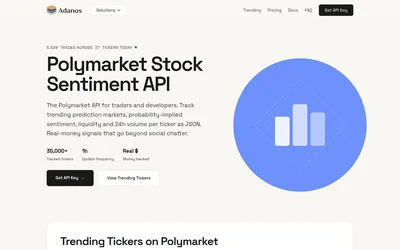

Aggregate Polymarket activity by stock ticker and compare it with Reddit, X and news sentiment through one API subscription.
- Data coverage Markets · Sentiment
- Access API · CLI
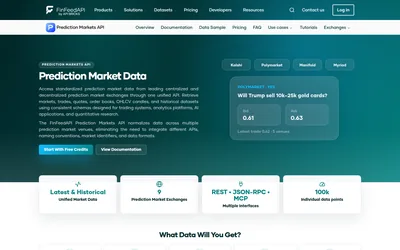

Access normalized prediction-market listings, trades, quotes, order books and historical candles through REST, JSON-RPC or MCP.
- Data coverage Markets · Trades · Prices · Order books
- Access API · MCP
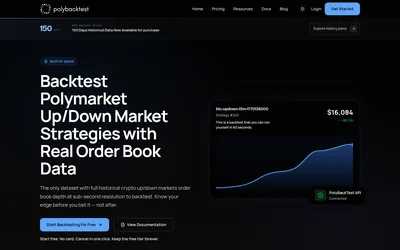
Replay crypto Up/Down markets using historical order-book depth and timestamped data.
- Access Web · API
Frequently asked questions about Polynode
Can I filter on the server?
Yes. Subscriptions support combinations such as wallets, tokens, market slugs and minimum size.
Does the free tier include V3 historical REST endpoints?
The rate-limit guide says standard V3 REST data requires a paid plan.
Are multiple API keys separate quotas?
No. Limits and monthly meters are shared by the account.
Does a capacity package raise requests per minute?
No. It adds capacity only to the selected monthly meter.
Is Polynode still available after joining Agg?
The product notice says existing APIs and documentation remain available.