 Polytoolhub
What is Poly SDK?
Poly SDK provides higher-level services on top of Polymarket integrations. Alongside markets and books, the repository includes smart-money tracking, copy controls, CTF operations and strategy examples. It is a developer toolkit: configuration and ongoing operation remain the responsibility of the application using it.
Who it is for
- TypeScript developers prototyping wallet-following strategies
- Builders who want ready-made service abstractions beyond raw API calls
- Researchers studying copy and two-leg strategy implementations
Features and coverage
- Available on
- TypeScript, Node.js
- Markets & venues
- Polymarket
- Market and wallet clients
Read Gamma discovery, account data and wallet-related information.
- Live smart-money tracking
Subscribe to selected wallet activity with address and size filters.
- Copy controls
Configure scale, maximum trade size, slippage, side filters and dry-run behavior.
- Arbitrage service
Scan books, size legs and manage configured execution and rebalancing.
- Dip strategy examples
Follow the two-leg state machine for short-duration crypto markets.
- CTF operations
Examples cover split, merge and redemption.
- Typed examples
The repository includes order, rewards, candle and WebSocket workflows.
Workflows with Poly SDK
Prototype wallet copying
Choose target addresses, set size scaling and a maximum, and run the dry-run path. Inspect detected and skipped trades before enabling signed execution.
Study a two-leg strategy
Trace the first fill, pending second leg and cleanup logic separately. A first-leg fill creates exposure even before a matching opportunity appears.
Pricing and total cost
MIT-licensed source code. Runtime, provider dependencies, venue fees and capital costs are separate.
Getting started
Before you start: Some documented dependencies and subgraph/RTDS examples are legacy surfaces that need compatibility review against current Polymarket docs.
- Open the official repository and read the current package instructions.
- Start with a public-data example.
- Select the service and configure explicit size and execution controls.
- Use dry-run behavior where provided.
- Check compatibility with current Polymarket contracts and feeds before a live integration.
Useful links
What to check
- Some documented dependencies and subgraph/RTDS examples are legacy surfaces that need compatibility review against current Polymarket docs.
- A two-leg strategy can remain exposed after only the first leg fills.
- autoExecute and dryRun change whether a service submits orders.
- Token-array shape changed across SDK versions; follow the version-specific migration notes.
A closer look
Ratings & reviews
User reviews 0
The main score switches to user ratings after 5 published reviews.
A specific example helps the next person choose the right tool.
Write a review
How was your experience with Poly SDK?
Share what you used, what worked and what could be better. We confirm your email and review the submission before publishing.
To submit a review, email info@polytradingbot.com with the tool name, your rating and your experience. Enable JavaScript to prepare a draft here.
Related tools
Browse category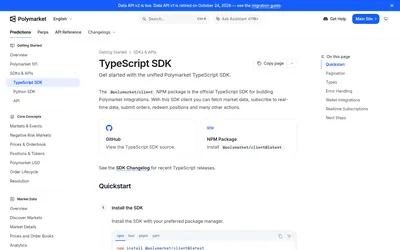

The official TypeScript SDK for public market data, typed pagination, real-time subscriptions and authenticated trading and wallet actions.
- Language TypeScript · JavaScript
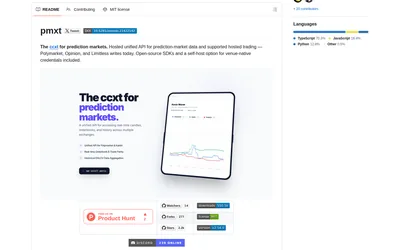

Use Python or TypeScript clients with a common prediction-market interface, targeting hosted PMXT or a locally run backend.
- Language Python · TypeScript
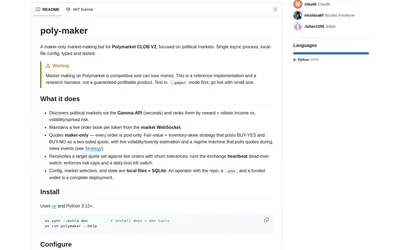
Run a configurable maker-only Polymarket bot with inventory-aware quotes, paper mode, market selection and exposure controls.
- Trading mode Paper · Live automation
- Access CLI
Frequently asked questions about Poly SDK
Is this the official Polymarket SDK?
No. It is a third-party toolkit with additional services.
Can I inspect copying without live orders?
The documented copy service includes a dryRun setting.
Does detecting an arbitrage complete both legs?
No. Detection, execution, partial fills and cleanup are separate states.