 Polytoolhub
What is Crosswire?
Crosswire checks whether two apparently matching contracts actually settle on equivalent events. The API returns a verdict with findings about settlement sources, timing, scope and void rules. This is useful between market matching and order execution: a shared title or strike is insufficient when one venue uses a different price index, closing time or cancellation policy.
Who it is for
- Developers building cross-venue strategies
- Researchers auditing matched event contracts
- Agents that need structured reasons for rejecting a market pair
Features and coverage
- Available on
- REST API, MCP
- Markets & venues
- Polymarket, Kalshi
- Research topics
- Settlement rules, Cross-venue research
- Settlement comparison
Inspect differences in oracle/source, settlement instant, event scope and void conditions.
- Structured verdict
Read SAFE, CAUTION or BLOCK together with specific findings and severity fields.
- Audit object
The response identifies the two legs, match confidence, rule flags, snapshot age and ruleset hash.
- Coverage discovery
List covered events and pair identifiers before asking for an audit.
- REST and MCP
Use the audit endpoint from code or call resolution-risk tools from an MCP client.
- Metered access
The crypto inventory uses an x402 payment flow on Base; public example pairs provide an onboarding path.
Workflows with Crosswire
Audit a proposed hedge
Resolve the pair to supported market references, request an audit, then inspect every divergence. Use the verdict and rule findings as separate inputs in the strategy’s eligibility check.
Keep an inspectable decision
Store the pair IDs, findings, snapshot age and ruleset hash with the decision so later analysis can reproduce which rules were evaluated.
Test the integration
Start with a covered free pair and confirm that the returned findings are handled before enabling any paid calls.
Pricing and total cost
The published metered audit price is $0.02 per call, paid in USDC on Base through x402.
Access: Covered World Cup example pairs are free to audit. Consult current coverage for the event family and access path you need.
Getting started
Before you start: Coverage is limited to the listed event pairs; the service is not a universal contract matcher.
- Read coverage and obtain the canonical event or pair identifiers.
- Choose the REST audit route or MCP connection.
- Use a free covered example to inspect the complete response shape.
- Implement handling for the verdict, individual findings and data age.
- For metered crypto calls, configure an x402-compatible payment client and an explicit request budget.
Useful links
What to check
- Coverage is limited to the listed event pairs; the service is not a universal contract matcher.
- It evaluates settlement compatibility and returns data; it does not place either trading leg.
- A fee-adjusted spread and semantic match do not remove an explicitly flagged timing or void-rule difference.
A closer look
Ratings & reviews
User reviews 0
The main score switches to user ratings after 5 published reviews.
A specific example helps the next person choose the right tool.
Write a review
How was your experience with Crosswire?
Share what you used, what worked and what could be better. We confirm your email and review the submission before publishing.
To submit a review, email info@polytradingbot.com with the tool name, your rating and your experience. Enable JavaScript to prepare a draft here.
Related tools
Browse category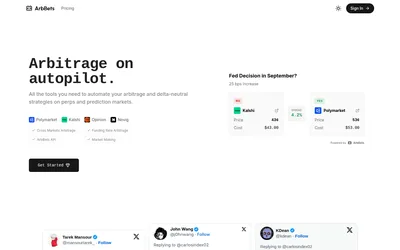
Scan cross-venue price differences, inspect the proposed legs and costs, and access opportunity data through a paid API.
- Data coverage Cross-venue matches
- Access Web · API
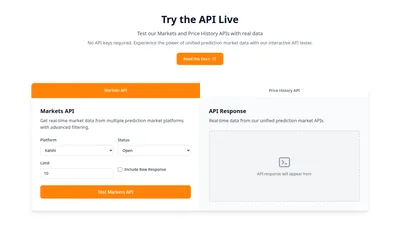

Build with one API for markets, order books, price history and sports data across seven venues.
- Data coverage Markets · Events · Order books · Trades · Prices · Sports events
- Access API · MCP
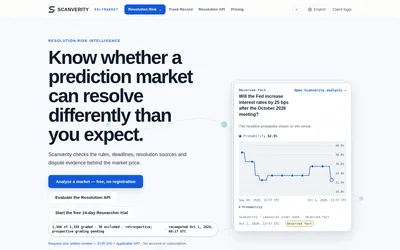

Review a contract’s rules, deadlines, resolution sources and dispute evidence, then monitor selected markets for changes.
- Data coverage Resolution evidence
- Access Web · API · Email
Frequently asked questions about Crosswire
What problem does it catch?
Contracts with similar names can use different settlement sources, times or cancellation rules. The audit names those differences.
Can an agent use it?
Yes. MCP exposes coverage discovery and resolution-risk checks.
Does it forecast the winner?
No. It compares the contracts and their rules.
What should I store with a result?
Keep the leg identifiers, findings, snapshot age and ruleset hash.